Research in the communications and information area is dedicated to developing theoretical concepts and approaches, models, techniques and algorithms for information measures, processing, communication, computation, and storage, broadly constructed, with focus on mathematical aspects of communication systems and networks. The research in this area plays a leading role in the development of the foundations of information and coding theory, statistical signal processing, and their relevance to all communications domains: wired, wireless optical and others. The research scope addresses timely basic problems including:
Fundamental limits in multiuser communications
Modern communications and coding. Coding problems in networking, storage and computation.
Fundamental limits in source coding problems. Universal source coding.
Relations between Information Theory and Machine Learning.
Practical communications and information aspects
Information theoretic data security and adversarial attack immunity.
The Communications-Information research field is central to current and future practical communications technologies and it reflects broad and also interdisciplinary aspects, connecting to: computer sciences, statistics and probability theory (large deviation aspects), physics (with focus on statistical physics) and mathematics (measure theory, optimization, combinatorics, random graphs and matrices).
Fundamental limits and ultimate bounds on reliable communication over channels and networks; multi user systems as exemplified by multiple access, broadcast, interference, relay channels, and computation in networks. The research scope accounts also for cooperative communications, arbitrary varying channels, delay limited reliable data transmission, variable rate channel and source coding and the like. This sub-topic includes also analytic conclusive views in the area of cloud, fog and open radio access networks, non-orthogonal multiuser communications (central elements for future 6G and beyond technologies).
Modern communications and coding accounting for unified approaches and aspects of modulation (frequency/time/space), multi-input multi-output processing and advanced coding (turbo/LDPC and Polar codes), coded computing, sparse resource allocation and compressive processing.
Fundamental aspects, limits and methods for information source coding under distortion measures, as well as optimal distortionless data compression.Universal algorithms and practical schemes for data compression (as the Lempel-Ziv algorithm), prediction, modeling, decoding, combined source/channel coding/decoding and noise removal.
Applications of machine learning algorithms and deep learning in communication problems. Statistical learning theory for data-compression and communication problems. Information-theoretic analysis of machine-learning algorithms and deep learning.
Practical communications and information aspects: Communications protocols under latency and reliability demands, network coding, computation in networks, network congestion and cognition, power constraints, caching procedures and theoretical aspects of limited memory.
Information theoretic data security and adversarial attack immunity. Information theoretic approach to all kind of adversary models: compound, random, arbitrarily varying models, topological uncertainty in channel and sources models, and more.
Research Interests: Information Processing in Fault-Prone Computer Systems: In particular, Codes for Novel Storage Technologies, Storage Architectures and Systems.
Research Interests: Information theory, signal processing, and networks. In particular, information processing, network information theory, network coding, security, distributed computation in networks, coding, anomaly detection, and speech enhancement.
Research Interests: Array Signal processing, speech enhancement, noise estimation, source localization, blind source separation, system identification, adaptive filtering, image analysis and processing, deep learning.
Research Interests: Shannon Theory, Information Theory and Statistics, Coding Theory, Codes Defined on Graphs and the Performance versus Complexity of Iterative Decoding Algorithms
Research Interests: Controlled stochastic models in communication networks, Large deviations methods for analysis, evaluation and design of communications and computing networks.
Research Interests: Optical Communication – Advanced optical modulation formats and equalization techniques, MIMO techniques over multimode optical interconnects;
Research Interests: Design and control of heterogeneous computer networks, Design and control of local wireless networks, Design and analysis of network protocols, Scheduling and QoS methods, Wireless communication networks, High speed communication networks.
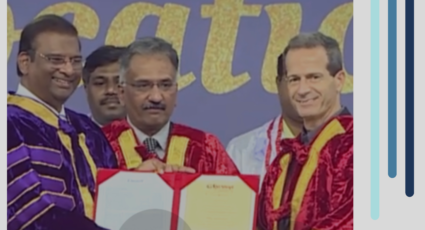
the Louis and Samuel Seiden Chair in electrical and computer engineering at the Technion, for receiving the Honorary Doctorate...
Manage Consent
We use cookies for essential operations, improving your experience, anonymous analytics, and personalized ads. You can allow all categories or fine-tune each one. Learn more: Privacy Policy